
Multiplication Worksheets
Times tables stick with short, regular practice. Choose which tables to practise and the type of question, and the generator makes a fresh printable worksheet with an answer key in seconds. The paid pack adds a full set of ready-made sheets — single tables, mixed facts, missing factors, arrays and one-minute drills — plus a progress chart so children can see their facts grow.
- Instant download
- Editable Word
- Print-ready PDF
- 7-day refund
18 files · PDF, DOCX
Multiplication Worksheets Pack
Printable multiplication worksheets with answer keys: every table 2–12, mixed facts at three levels, missing factors, related division, one-minute drills, a blank 12×12 grid and a fact tracker.
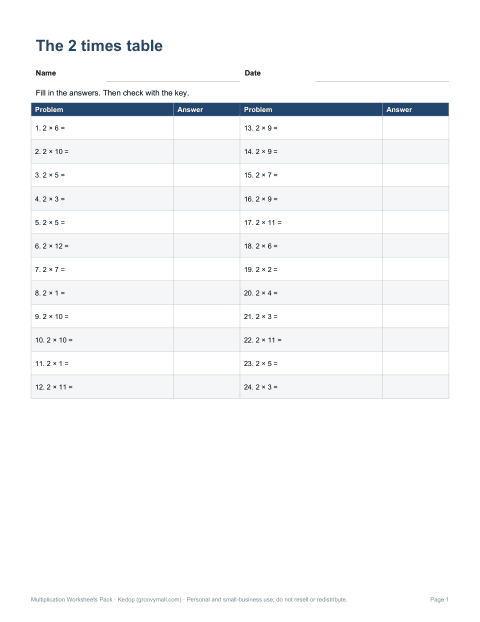
- 2 times table (PDF, DOCX)
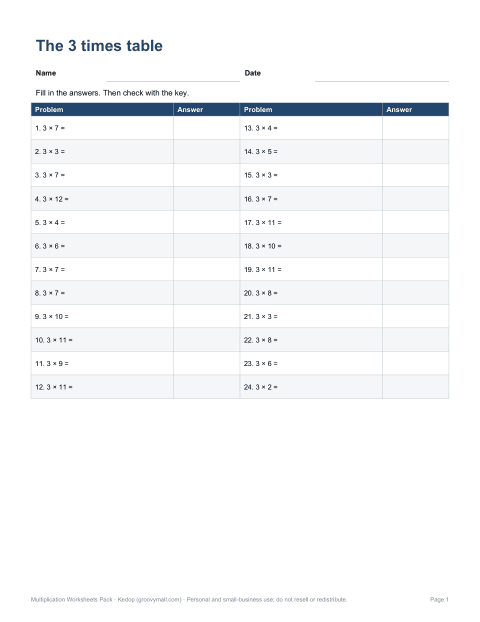
- 3 times table (PDF, DOCX)
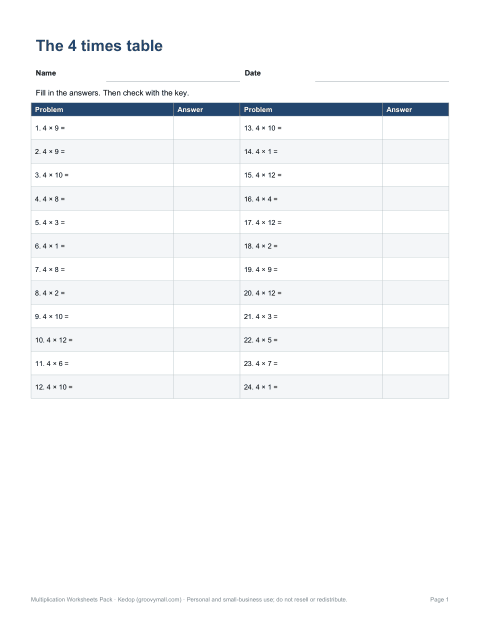
- 4 times table (PDF, DOCX)
- + 15 more
$5.00 USD, one-time 18 files · about $0.28 each
- Instant download
- 7-day refund
- Secure checkout by Stripe
7-day money-back guarantee. Full refund within 7 days of purchase, even after you download.
Free sample: Times Table 2 (PDF, 55 KB)
Multiplication Worksheets Pack
Printable multiplication worksheets with answer keys: every table 2–12, mixed facts at three levels, missing factors, related division, one-minute drills, a blank 12×12 grid and a fact tracker.
- 2 times table (PDF, DOCX)
- 3 times table (PDF, DOCX)
- 4 times table (PDF, DOCX)
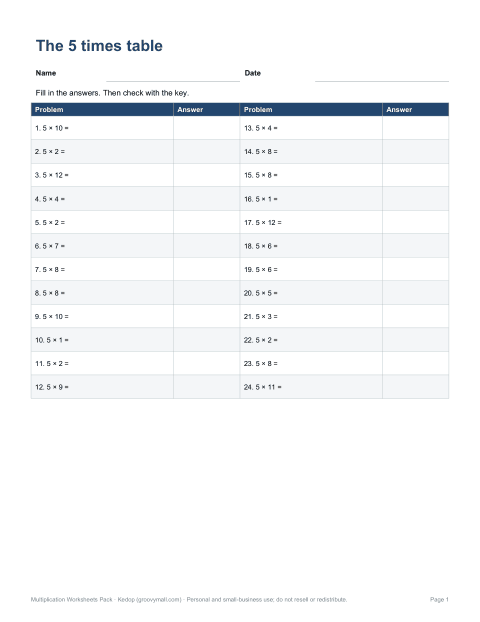
- 5 times table (PDF, DOCX)
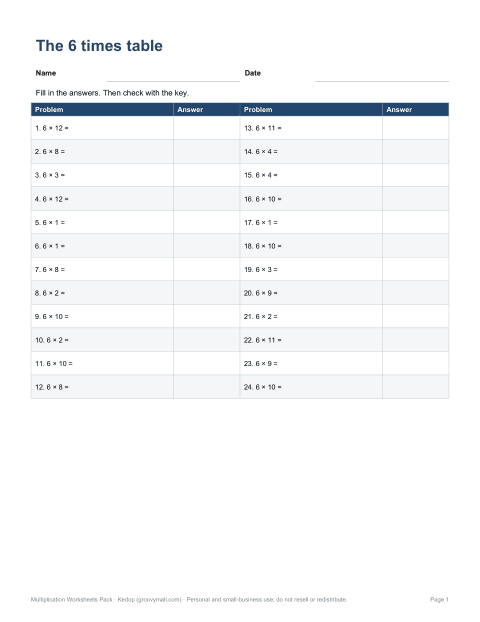
- 6 times table (PDF, DOCX)
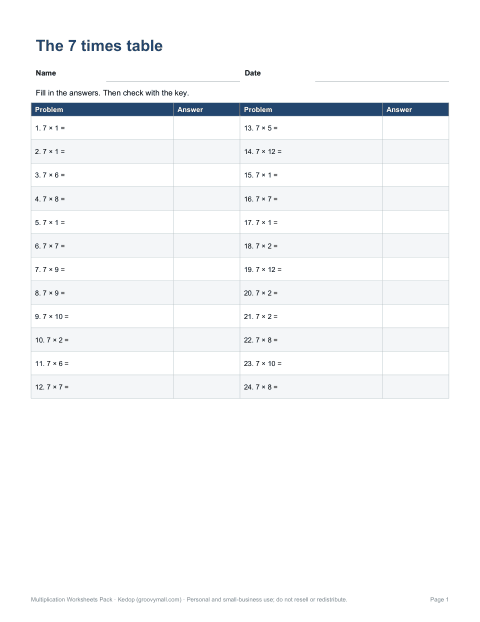
- 7 times table (PDF, DOCX)
- 8 times table (PDF, DOCX)
- 9 times table (PDF, DOCX)
- 11 times table (PDF, DOCX)
- 12 times table (PDF, DOCX)
- Mixed facts level 1 (PDF, DOCX)
- Mixed facts level 2 (PDF, DOCX)
- Mixed facts level 3 (PDF, DOCX)
- Missing factors (PDF, DOCX)
- One-minute drill (PDF, DOCX)
- Blank 12×12 grid (PDF)
- Completed chart (PDF)
- Fact tracker (PDF/DOCX)
Formats: PDF, DOCX. Instant download after payment (link valid 72 hours, up to 5 downloads). AI-assisted: the templates were drafted with AI help and reviewed and laid out before publishing.
$5.00 USD, one-time 18 files · about $0.28 each
- Instant download
- 7-day refund
- Secure checkout by Stripe
7-day money-back guarantee. Full refund within 7 days of purchase, even after you download.
Free sample: Times Table 2 (PDF, 55 KB)
Full refund within 7 days — see the refund policy and license.
Free printables
Single sheets you can print right now, no sign-up. The full pack adds every sheet in one download plus the editable files.
 Printable 2 Times Table Worksheet2 pages · free PDF
 Printable 3 Times Table Worksheet2 pages · free PDF
 Printable 4 Times Table Worksheet2 pages · free PDF
 Printable 5 Times Table Worksheet2 pages · free PDF
 Printable 6 Times Table Worksheet2 pages · free PDF
 Printable 7 Times Table Worksheet2 pages · free PDF
 Printable 8 Times Table Worksheet2 pages · free PDF
 Printable 9 Times Table Worksheet2 pages · free PDF
Multiplication worksheet generator
Why times tables still matter
Quick recall of multiplication facts frees up working memory for harder maths — long multiplication, division, fractions, ratio and algebra all lean on them. Children who have to count up to find 7 × 8 lose track of the bigger problem. Most school curricula expect children to know their tables up to 10 × 10 or 12 × 12 by the end of primary school, around age 9 to 10.
A sensible order for learning the tables
| Stage | Tables | Why |
|---|---|---|
| 1 | 10, 2, 5 | Easy patterns: add a zero, doubles, counting in fives |
| 2 | 3, 4 | 4 is double 2; 3 builds on counting |
| 3 | 11, 9 | 11 has a repeating pattern to 9 × 11; 9 has the finger trick |
| 4 | 6, 8 | 6 is double 3; 8 is double 4 |
| 5 | 7, 12 | Fewest new facts left to learn by now |
| 6 | Mixed | Random order proves real recall |
Remember that each fact learned covers two: 3 × 7 and 7 × 3 are the same. Once the 2s, 5s and 10s are secure, fewer than 40 genuinely new facts remain in the 12 × 12 grid.
Types of worksheet and what they build
- Single-table sheets — focus on one table in order, then shuffled.
- Mixed facts — test recall across several tables.
- Missing factor (6 × ___ = 42) — links multiplication to division.
- Related division (42 ÷ 6) — practises the inverse fact.
- Arrays — rows and columns of dots show what multiplication means.
- Timed drills — build speed once facts are accurate.
How to practise effectively
- Practise little and often: five to ten minutes most days beats an hour once a week.
- Start with accuracy, then add a timer.
- Mark straight away and correct mistakes together.
- Keep a list of “tricky facts” and revisit them first next time.
- Mix written sheets with games, songs and quick oral quizzes.
- Celebrate progress on the fact tracker.
Handy tricks
| Table | Trick |
|---|---|
| 9s | Tens digit goes up, units digit goes down: 18, 27, 36…; digits add to 9 |
| 11s | Up to 9 × 11, repeat the digit: 44, 55, 66 |
| 4s | Double, then double again |
| 8s | Double three times |
| 6s | Times 5, then add one more group |
| 12s | Times 10 plus times 2 |
Worked example
A parent ticks the 3, 4 and 6 tables, chooses “Missing factor” and 20 questions, and adds their child’s name. The generator produces questions such as 6 × ___ = 42 and 4 × ___ = 36. The child completes the sheet, the parent prints the answer key to mark it, and the two facts they got wrong go on a sticky note for tomorrow.
What is in the paid pack
The template pack includes a sheet for every table from 2 to 12, mixed-fact sheets at three levels, missing-factor and division sheets, array pictures, one-minute drills with answer keys, a blank 12 × 12 grid to fill in and a fact-tracker chart. Print them as often as you like for your family or class.
Privacy
The generator runs in your browser; nothing is uploaded.
Frequently asked questions
What age should children know their times tables?
Many curricula expect recall up to 12 × 12 by around age 9 to 10.
Which times table should be learned first?
Usually the 10s, 2s and 5s.
How long should practice take?
Five to ten minutes most days.
Are answer keys included?
Yes, both the generator and the paid pack include answer keys.
Can I choose which tables to practise?
Yes, tick any tables from 1 to 12 in the generator.
What is a missing factor question?
A question like 6 × ___ = 42, which links multiplication to division.
Was AI used?
The worksheets are generated by script; guidance text was drafted with AI assistance and reviewed before publishing.